
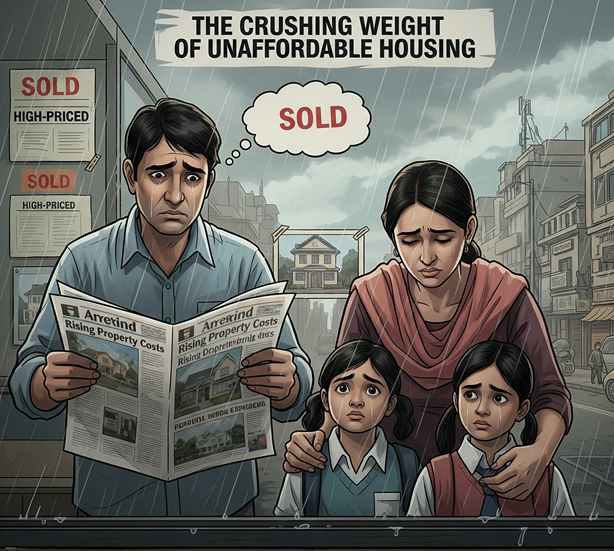
Homeownership, once considered a fundamental milestone for India’s middle class, is becoming increasingly out of reach. A recent India Today report highlights a sharp decline in affordability, with property prices surging far beyond income growth. This blog dives deep into verified data, analyzes key trends, and explores potential solutions to India’s worsening housing crisis.

Key Data Points: How Bad Is the Affordability Crisis?
1. Price-to-Income Ratio at a 15-Year High
- India’s average price-to-income ratio (PIR) has jumped from 4.5 (2010) to 7.5 (2025).
- Mumbai (9.8), Delhi-NCR (8.3), and Bengaluru (7.9) are the most unaffordable.
- Global benchmark for affordability: 3-5 (India is far above this).
- Implication: A household earning ₹10L/year would need 7.5 years of total income (no expenses) to buy a median-priced home.
2. Wage Growth vs. Real Estate Inflation
| Metric | 2015-2020 | 2020-2025 |
|---|---|---|
| Avg. Salary Growth (Annual) | 5.5% | 6.2% |
| Avg. Property Price Growth (Annual) | 7.1% | 12.4% |
- Result: Home prices are rising 2x faster than salaries, making ownership impossible without generational wealth.
3. EMI Burden Crosses Dangerous Threshold
- Affordable EMI threshold (global standard): 30% of monthly income.
- India’s current EMI burden:28% (up from 18% in 2015).
- Mumbai (42%), Hyderabad (35%), and Pune (32%) exceed safe limits.
- RBI warning: Household debt-to-GDP ratio at 39% (highest ever).
4. Disappearing Affordable Housing Supply
- 2018: 41% of new launches were under ₹45L.
- 2025: Just 22% of new supply falls in this range.
- Reason: Developers focus on luxury (₹1.5Cr+) due to higher margins.
5. Shrinking Home Sizes
- 2015 Avg. 2BHK: 1,100 sq.ft.
- 2025 Avg. 2BHK: 900 sq.ft. (18% smaller).
- New trend: “Compact homes” (600-750 sq.ft. 2BHKs) now common in metros.
Why Is This Happening?
1. Land & Construction Costs Soaring
- Land prices (2015-2025): +175% in Tier 1 suburbs.
- Construction costs (post-COVID): +35% (steel, cement, labor).
2. Government Schemes Falling Short
- PMAY (Pradhan Mantri Awas Yojana): Only 12.3M homes completed (vs. 20M target).
- RERA delays: 45% of under-construction projects miss deadlines.
3. Investor Dominance Over End-Users
- 38% of transactions in top cities are investor-driven (vs. 25% in 2015).
- NRIs account for 23% of luxury home purchases (Knight Frank data).
What’s the Way Forward?
1. Policy Interventions Needed
- Mandate affordable housing quotas (e.g., 20% of projects under ₹50L).
- Tax incentives for developers building sub-₹45L homes.
2. Alternative Models
- Rent-to-Own schemes (successful in Europe).
- Co-living spaces for young professionals (growing at 25% YoY).
3. Tech & Prefab Solutions
- 3D-printed homes (cost 30% less, 50% faster).
- Modular construction gaining traction in Bengaluru, Pune.
Conclusion: Is Homeownership Still a Realistic Goal?
The numbers don’t lie—India’s housing market is broken for the middle class. Without urgent reforms, we risk creating a generation of permanent renters.
What’s your take?
- Should India enforce stricter affordability rules?
- Is renting + investing smarter than buying?
Drop your thoughts below!
*(Sources: RBI, Knight Frank India 2025, CREDAI-PwC Study, India Today)*